Introduction
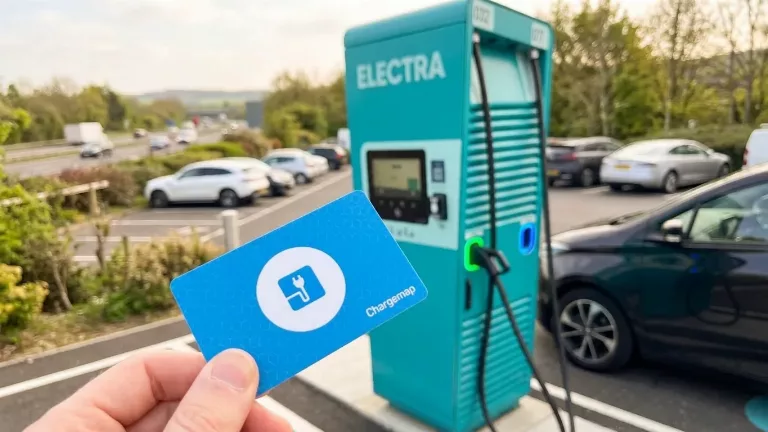
The European charging market is entering a new phase. For a long time, Chargemap mostly made drivers' lives easier. Its app and its multi-network card became a reference point. Electra, by contrast, chose to build rapid charging stations itself.
Yet over recent months the two companies have converged on unexpected ground. Electra has just launched its own multi-network card. Chargemap, meanwhile, now sits inside a group, Brakson, whose technological ambitions reach well beyond a map of charge points.
So in the Electra vs Chargemap contest, which has the brighter future?
The answer depends on which criterion you pick. Chargemap has a long-established community and solid data expertise. Electra controls a rapidly expanding physical infrastructure, and has just shifted towards an aggregator model. The real question is therefore no longer only who will unseat whom. It is which layer of electric mobility becomes the more strategic one: the infrastructure, or the interface.
Two histories, two different starting points
Before comparing the two companies, it helps to understand where each of them came from.
The idea for Chargemap took shape in 2010. Yoann Nussbaumer was unsuccessfully looking for somewhere to charge his future electric car. So he imagined a collaborative tool for locating charge points. In 2011 he launched it in earnest with a handful of enthusiasts (Chargemap — About). That small team documented charge points across France. The model was reminiscent of Wikipedia or Waze: drivers sharing photos, reviews and reports.
Electra followed the opposite trajectory. Founded in 2021, the company focused from the outset on physically building stations. Its first charge point opened in Aubervilliers in January 2022 (Journal Auto).
Chargemap, then, began by building a community and a database. Electra began by building concrete, copper and transformers. That difference explains almost everything that follows.
Chargemap: fifteen years of community and data
The Chargemap Pass marked a turning point. Faced with a proliferation of proprietary cards, Chargemap conceived a single one. The company presented itself at the time as the "Booking.com of charging" (Le Journal des Entreprises).
In 2016, Cap Innov'Est invested €500,000 in the company, topped up by roughly €500,000 in grants and loans. The Chargemap Pass then launched in June 2017, after several months of negotiation with charge point operators (Brakson — Overview).
Today Chargemap claims more than 3.5 million drivers across 19 European countries — a sharp rise on the 2.8 million users counted at the end of 2023 (Chargemap — New identity). The company has also developed its own route-planning technology, and has integrated Autocharge and Plug&Charge to reduce reliance on the physical card.
That community is a strategic asset which is hard to replicate quickly. The more users there are, the more data Chargemap gathers. And the more data there is, the more useful the app becomes.
Brakson: the key to understanding Chargemap’s future
This is probably the single most important element for understanding Chargemap's future.
In 2018, Yoann Nussbaumer created Brakson, the group's holding company. It brings together Chargemap, Automobile Propre, Révolution Énergétique, Mister EV and Cleanrider. In 2022, Brakson bought out the Chargemap shares held by Cap Innov'Est, ending more than five years of the fund’s presence among its shareholders (Brakson — Overview).
Since then, Chargemap has grown without a new external funding round. Brakson presents itself as a self-financed and independent group. It states that it invests in R&D, digital technologies and artificial intelligence, and it also develops media and services around the energy transition (Brakson — Overview).
That independence changes the comparison with Electra profoundly. Chargemap is no longer simply an app looking for users. It is now one component of a group whose strategy spans mobility, data, media and, potentially, AI.
Chargemap no longer wants to be only a charge point map
Chargemap's recent history already demonstrates this ability to expand beyond the map.
The company offers Chargemap Business for companies, and Chargemap Partners for charge point operators. In that B2B segment, Chargemap Business grew from 3,500 to more than 4,100 corporate customers in a year. Over the same period, 6 million charging sessions were carried out via the Chargemap Pass in 2025 (Make a Move).
The direction of travel is therefore fairly clear. Chargemap is gradually moving from a charge point map to a platform of services around charging — for private drivers and fleet managers alike.
Towards an energy copilot? A hypothesis, not a settled fact
Here it is worth separating facts from prospects. Brakson states that it invests in artificial intelligence. But the group has not publicly announced that Chargemap would become an "operating system" for the electric car. That evolution therefore remains a hypothesis.
It does, however, look consistent with the assets already in place. Chargemap has a rich geographic database, an active community and long experience of route planning. Imagine an app able to cross-reference real consumption, weather, traffic, battery level and charge point reliability. It would no longer merely be looking for a charge point. It would be looking for the best energy strategy for a given journey.
That is an ambitious prospect. But at this stage it remains a reasonable extrapolation from Chargemap's assets. It is not yet a confirmed roadmap.
Electra: extraordinary financial acceleration
Against Chargemap, Electra holds a different weapon: speed of execution, carried by considerable funding.
In 2022, Electra raised €160 million. The round was led by Eurazeo, alongside RGREEN Invest, RIVE Private Investment, Serena, Groupe Chopard, SNCF 574 Invest and RATP Capital Innovation (go-electra.com).
In January 2024, the company closed a €304 million round led by the Dutch pension fund PGGM. Bpifrance also came onto the cap table through its Large Venture fund (Bpifrance).
Then, in July 2025, Electra secured up to €433 million in bank financing. This time it was debt rather than equity. The transaction brought together ING, MUFG, ABN AMRO, Société Générale, Rabobank, Bpifrance, Caisse d'Épargne Hauts-de-France and Banque Populaire Val de France (Bpifrance). Electra states that it has thereby passed €1 billion in financing secured since its creation.
That shift from venture capital to bank debt is telling. Banks and institutional investors do not finance a mere app feature. They finance infrastructure expected to produce revenue over several decades.
2025, the year Electra had to prove its model
Results published in early 2026 confirm the trajectory. Electra reached 644 stations at the end of 2025, close to 4,000 charge points. The company added 244 new sites in a year, a 61% increase (Electra — 2025 review).
More interesting still: average station utilisation rose by 62% over the same period, and revenue tripled. Electra is now targeting operational profitability in 2026. The revised objective is more than 1,300 stations and 7,500 charge points by 2027 (Link2fleet).
That combination is more important than simply increasing the number of charge points. Building stations is not enough. Drivers also have to actually use them, or the capital-intensive model does not hold up.
A European ambition that is accelerating
Longer term, Electra is targeting 2,200 stations and 15,000 high-power charge points across Europe by 2030 (Mobility & Energy). The company is also multiplying partnerships, working with VINCI Autoroutes, Indigo, AccorInvest, Stellantis and Hertz among others.
Electra is now going after the corporate fleet market too. It is targeting more than 1,200 partner fleets by the end of 2026, up from 600 today, and highlights access to 150,000 charge points in France through a single card aimed at businesses (Automobile Propre).
Electra is therefore no longer simply building a charging network. It is trying to become a reference player in European electric mobility infrastructure, across both private and professional segments.
Energy, Electra's next playing field
Electra describes some of its stations as intelligent energy hubs. The company has begun deploying connected stations, branded Electraline, and is integrating batteries at sites with limited grid capacity (Electra — 2025 review).
A rapid charging station consumes an enormous amount of electricity over a short period. A local battery smooths that consumption out. Software can then optimise use of the grid and of internal resources in real time.
Electra could therefore gradually become something other than a charge point operator. It could become an operator of small distributed energy hubs. That evolution is still in its early stages, though, and currently concerns a limited number of sites.
Renewable electricity: what Electra actually says
Electra states that it supplies 100% renewable electricity across its network, through the Guarantees of Origin (GO) system. For every kWh sold, one kWh of renewable origin is produced and injected into the European grid. The company estimates it thereby avoided 27,500 tonnes of CO₂ in 2024 (go-electra.com).
That mechanism does need qualifying, however. The electrons physically arriving in a car cannot be sorted by origin. A Guarantee of Origin is therefore an accounting traceability mechanism, not a physical separation of electricity. It does not make the electricity "physically solar". The scheme does nevertheless genuinely support the development of renewables.
It is also worth remembering that the French electricity mix is already very low-carbon. Renewable and low-carbon are therefore not perfect synonyms. Electra does deserve credit for making its energy policy explicit and verifiable.
Chargemap can no longer take its card advantage for granted
This is the most significant development since the earliest versions of this article. On 29 June 2026, Electra changed its status. The company is no longer simply a charge point operator: it has become a mobility service provider, or eMSP.
It opened its app to 800,000 third-party charge points across Europe, including Ionity, Fastned, TotalEnergies and Allego. It also launched a universal RFID card, sold at €4.99 and free for Electra+ subscribers (Automobile Propre). For comparison, the Chargemap Pass sells for around €14.90, with no compulsory subscription (Tesla Mag).
That pivot changes the nature of the duel. Electra is no longer merely rounding out its offer with a secondary card. It is attacking Chargemap's historic core business directly, at a more competitive price. Chargemap keeps its lead in user volume, but no longer has the same clear lead on multi-network interoperability.
Electra vs Chargemap: the comparison table
| Criterion | Chargemap / Brakson | Electra |
|---|---|---|
| Founded | 2010-2011 | 2021 |
| Core model | Technology platform | Charging infrastructure |
| Community | > 3.5 million across 19 countries | Smaller, growing fast |
| Own infrastructure | No | Yes, 644 stations at end of 2025 |
| Multi-network card | Yes, long-established | Yes since June 2026, 800,000 points |
| Capital raised / secured | Relatively low, self-financed | > €1bn secured |
| Physical growth | Limited | +61% stations in 2025 |
| Renewable energy | Depends on the network used | 100% renewable claimed (GO) |
| Energy management | Potential still theoretical | Already integrated at some sites |
| Main risk | Competition from built-in systems | Profitability of the capital-intensive model |
A partnership that has continued since 2022
It would be tempting to present Electra and Chargemap as two strictly opposed competitors. The reality is more subtle.
Since February 2022, Electra charge points have been accessible from the Chargemap app, with no additional roaming fee charged to Chargemap Pass holders (go-electra.com). In other words, Electra builds the infrastructure while Chargemap organises part of the access to it. Both companies therefore gain at the same time, whenever a Chargemap driver charges at an Electra point.
That complementarity could even persist in a more mature market — despite the now-direct competition on multi-network cards.
The risks specific to each model
Each strategy carries its own point of fragility.
For Chargemap, the threat comes from built-in systems. Carmakers increasingly integrate charge point search into their vehicles. Google and Apple are developing their own mapping services too. Chargemap must therefore keep offering more than a simple display of charge points. That explains the investment in Chargemap Business and in fleet management tools.
For Electra, the risk is financial. Every station is expensive to build, connect and maintain before it generates revenue. The company must turn that billion euros of financing into a network of sufficiently well-used stations. It says it intends to meet that challenge as early as 2026, although the outcome is not yet assured.
Chargemap: four possible paths forward
Beyond the verified facts, four possible paths stand out for Chargemap.
Becoming the software layer of charging. The company already has a community, a database, a payment system, a card and a B2B business. The logical next step is making those components work together.
Going deeper into artificial intelligence. The volume of available data could improve availability forecasting. It could also refine estimated charge point reliability and route recommendations.
Strengthening the B2B position. The corporate fleet market is already growing strongly at Chargemap Business. It could become as important as the consumer service.
Exploiting the Brakson ecosystem. The group combines media, commerce and technology around mobility. That is a combination Electra does not have in the same way.
Conclusion: two bets, not a duel with a single winner
The headline "Electra vs Chargemap" suggests a head-on clash. Yet the most likely scenario remains two parallel trajectories, now partially competing in the card market.
Electra is building physical assets that are hard to reproduce. It has considerable financial resources and shows measurable growth. Its bet is industrial and capital-intensive: turning more than a billion euros of investment into a profitable network.
Chargemap, for its part, is betting on a long-established community and unique data. It also leans on an independent group that says it wants to invest in artificial intelligence. Its bet is technological and requires far less capital.
The two companies remain interoperable today. Their models could continue to complement one another, even as competition intensifies over the interface. If I nevertheless had to pick a favourite for the infrastructure of tomorrow, it would be Electra. Its speed of execution and already-secured financing weigh in the balance. But Chargemap, backed by Brakson, remains a company to watch closely rather than one to underestimate.