Introduction
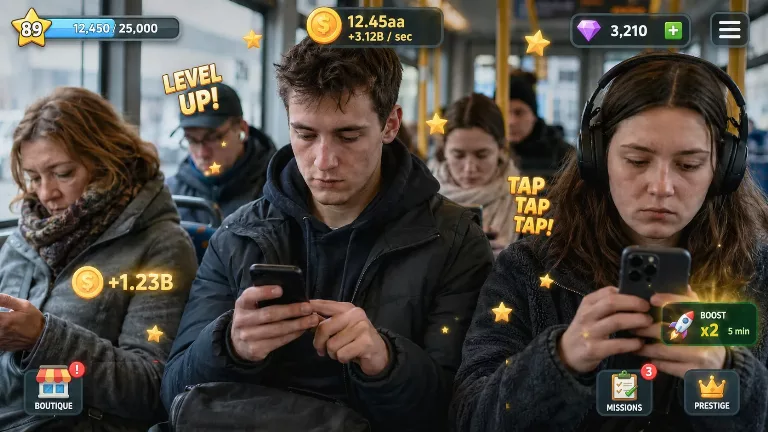
On the bus, on the tram, in waiting rooms: everywhere, people sit with their eyes fixed on their screen. A thumb taps the same spot, over and over. Indeed, there's no dialogue to scroll through, no opponent to face, no level to think through. Just a repetitive tap, punctuated each time by a slightly different sound. A coin jingles, a progress bar fills with a satisfying "whoosh." A quiet fanfare plays whenever a milestone is reached. The player, meanwhile, seems absorbed, almost hypnotized.
These are clicker games, or idle games, literally "inactive games." Their success is massive, too. Titles like Cookie Clicker, Clicker Heroes, and AdVenture Capitalist have attracted tens of thousands of players. Indeed, some have even crossed into the hundreds of thousands. And the genre keeps spinning off ever more mobile variants.
The problem is that this success is no happy accident. It rests on a precise psychological mechanism. That mechanism has, in fact, been documented for decades in a very different industry: gambling. Behind every satisfying little sound, however, sits an entire industry, one whose revenues run into several billion dollars a year.
A Game Without Play
An idle game, by definition, demands the least possible interaction. The player taps a cookie, a button, an icon. They accumulate a virtual currency, then buy "upgrades" that automatically increase earnings, with nothing left to do. Progress continues even when the phone is sitting face-down on a table. That, in fact, is the whole point of an "idle" game. Indeed, there's no real strategy, no decision that requires actual thought, no opponent to read, no skill to develop. The player stays fundamentally passive, simply watching numbers go up.
This is, in fact, one of the recurring criticisms leveled at the genre. Can you still call it a "game" when there's no real obstacle to overcome? Can you call it that when no decision truly matters? An idle game merely simulates the feeling of accomplishment, without ever asking for the effort that would normally justify it.
The Mechanism Borrowed From Casinos
Dopamine, Calibrated Like a Casino
This is where things get serious. Every tap, every level cleared, every reward sound triggers a release of dopamine. That neurotransmitter is tied to anticipation and reward-seeking. This isn't a metaphor, either: it is, in fact, the very mechanism behind the design of modern gambling machines.
Anthropologist Natasha Dow Schüll, a professor at MIT, spent fifteen years conducting field research on slot machines in Las Vegas. She turned that research into her landmark book, Addiction by Design (2012). Her conclusion: slot machines aren't designed for the player to win. Instead, they're designed to keep the player connected for as long as possible, in a trance-like state she calls "the zone." Her work shows that a stream of frequent, continuous small rewards ends up generating more revenue than a system of rare, large rewards. The reason is simple: that stream keeps players engaged far longer. This principle is inherited from psychologist B.F. Skinner's work on reinforcement. It explains why small, uninterrupted gratifications capture attention far more effectively than a single large, spaced-out reward.
An Industry That Openly Admits It
And that's exactly the architecture of an idle game: an almost continuous stream of micro-rewards. A sound, a rising number, a filling bar, a milestone that "pops." Nothing ever lets the brain settle back into calm. Indeed, some creators of these games openly admit as much. One independent developer recently described building a clicker game quite deliberately. He explicitly drew on knowledge of behavioral psychology, gambling design, and addictive design. He also stated that nothing in the game's mechanics was left to chance.
This parallel between video game design and slot machine design is, indeed, no longer an isolated intuition. Professor Mark Griffiths, a specialist in behavioral addictions at Nottingham Trent University, has studied the question closely. He has explained that social media platforms exploit the same variable-interval reinforcement schedules. It's precisely these schedules that drive users to compulsively check their screens.
Who Makes Money From Idle Games
A Structured, Profitable Sector
This isn't a small cottage industry. Indeed, it's a structured business, dominated by a handful of publishers specializing in "hybrid casual" or "idle" games. Large, publicly traded companies, moreover, play a central role here.
| Publisher | Specialty | Published figures |
|---|---|---|
| Homa Games | Pioneer of "arcade" idle games, over 200 games published | Over $20 million in in-app purchase revenue, nearly 2 billion cumulative downloads |
| SayGames | Hybrid casual publisher, over 150 games | About $142 million in in-app purchase revenue, nearly 6 billion cumulative downloads |
| Playtika | Social casino and casual games (Slotomania, Solitaire Grand Harvest) | About $2.75 billion in revenue in 2025, over 800 million cumulative downloads |
| Voodoo, Rollic, Azur Games, Lion Studios | Major "hybrid casual" players, including many idle/incremental titles | Portfolios of several hundred games, tens to hundreds of millions of dollars in revenue for top-performing titles |
A Fragmented Yet Massive Market
Analysts describe the global idle games market as fragmented. No single publisher exceeded 8 to 10% of overall sector revenue in 2025. Some sub-genres, such as idle RPGs, do show higher concentration, though. This fragmentation shouldn't obscure the scale of the phenomenon, however. Indeed, a handful of hit titles alone generate tens of millions of dollars a month. Overall, the entire "casual" and "idle" mobile gaming sector is now worth several billion dollars a year.
Playtika, one of the sector's biggest players, also illustrates the tensions this creates. The company has explicitly flagged a regulatory and legal risk in its financial filings. That risk is tied to its social casino-style mechanics and chance-based systems. It notably concerns Washington State, in the United States.
How the Industry Exploits "the Zone" to Drive Spending and Ad Views
This isn't an unintended side effect, either. Professional documentation aimed at mobile game developers describes, quite openly, how to turn this state of continuous engagement into revenue.
Rewarded Advertising, the Genre's Economic Backbone
According to the specialized platform adjoe, in-app advertising typically accounts for 60 to 70% of total idle game revenue. So-called "rewarded" ads are considered the genre's most effective format. In these, the user watches a 15 to 30-second video in exchange for a bonus. A guide aimed at idle game developers explains that these rewarded ads become a design tool in their own right. They offer a temporary doubling of earnings, a small amount of premium currency, or the option to skip a timer. The stated goal is simple: the ad should never be perceived as a burden. Instead, it should feel like a voluntary shortcut, almost a favor done for the player.
Segmenting Players by Willingness to Pay
Industry literature on mobile game monetization describes a segmentation model that has, in fact, become standard practice. Players are sorted into tiers, from "non-spenders" up to "whales," the biggest spenders. As a result, each tier receives a different experience. Non-spenders are shown more rewarded ads and lower-priced entry offers. "Whales," meanwhile, receive exclusive deals and early access to premium content. This targeting, in fact, relies on analyzing each player's behavior, spending history, and engagement level.
Mechanics Catalogued as "Dark Patterns"
Human-computer interaction researchers have built a taxonomy of manipulative design techniques used in highly profitable games. They sort these into three families. Temporal patterns manipulate the time a player must invest to progress. Monetary patterns, meanwhile, push toward repeated purchases or obscure the real cost of transactions. Finally, social capital patterns exploit relationships between players, pressuring them into recruiting friends or competing against each other. The US Federal Trade Commission officially defined the "grinding" technique in 2022. It involves deliberately making a free version of a game tedious and time-consuming. The goal is to push the player toward unlocking features with real money.
In other words, the perceived slowness of an idle game isn't always a simple design flaw. It can, instead, be a deliberate commercial lever. The longer the wait, the more attractive the paid offer that shortens it becomes.
The Illusion of Achievement
What makes the process particularly insidious is that it simulates a real sense of achievement. A quest progresses, a score climbs, a collection grows. All the visual and audio signals of success are there. The brain, however, reacts as if it had accomplished something concrete. In fact, it has only pressed a button, over and over, with no effort, no skill, and no thought required.
The contrast is striking with what psychologist Mihaly Csikszentmihalyi theorized as "flow." This concept describes an optimal state of engagement, one that requires a genuine balance between the challenge offered and the player's skill. Critics of the idle genre point out that it relies on none of these ingredients of a genuine challenge. Instead, it relies only on a sequence of immediate gratifications, with no dimension of mastery. A game that demands real skill, however, delivers earned satisfaction. An idle game, by contrast, produces the feeling without the substance. It teaches the brain to expect a reward without ever having built anything to deserve it.
A Family of Mechanisms, Not an Isolated Case
A Lever Shared With Social Media
Idle games aren't a marginal, isolated phenomenon. They belong to a much broader family of digital products, built consciously or not on the same levers. Think of the infinite scroll of TikTok or Instagram, notifications, and disappearing "stories." Gamification scores and badges belong to that family, too. One article on these mechanics sums up the shared logic well. What casinos achieve with carpets, hidden clocks, and chips, apps achieve differently. They rely instead on pixels, algorithms, and notifications. Both environments are, in fact, designed to bypass natural self-regulation, and both profit when you lose track of time.
What the Research Shows
This is precisely why academic researchers have started looking at screen mechanics as a whole. They no longer limit themselves to video games alone. "Internet Gaming Disorder" has appeared in the DSM-5, psychiatry's reference diagnostic manual, since 2013. It appears there not as an officially recognized disorder, but under the section "conditions for further study." Among the nine proposed criteria for identifying it: constant preoccupation with gaming, and irritability when deprived of it. There's also the need to play more and more to feel the same satisfaction, and failed attempts to cut back. Loss of interest in other activities and using games to escape negative emotions round out the list. Meanwhile, more recent research has tested these same criteria on compulsive social media use. It found they applied just as well. This reinforces the idea of a shared mechanism, rather than a problem specific to one type of screen.
What Science Hasn't Settled Yet
In fairness, science hasn't settled the matter yet. Placing "Internet Gaming Disorder" in a mere "section for further research" in the DSM-5 is telling. It signals that the scientific community remains cautious. It also stays divided over the thresholds, criteria, and exact nature of the phenomenon. But the lack of a definitive clinical consensus shouldn't overshadow one thing. A great deal is, in fact, well documented and openly acknowledged by the industry itself, in its own design guides. These games are engineered, mechanic by mechanic, to maximize screen time. They're also engineered to maximize ad views and the likelihood of spending. They aren't built to educate, to entertain in any meaningful sense, or to build any real skill.
See Through the Game
An idle game isn't dangerous the way a substance can be. But by design, it shares the same levers that make certain digital products hard to put down. It offers frequent, predictable rewards, along with sound and visual design built to reinforce every interaction. It adds, too, the illusion of an achievement that costs no real effort. Add to that an industry that openly documents, in its own design manuals, how to turn this state of absorption into money. It turns that absorption into ad revenue and purchases. The result is a product engineered to occupy as much of your attention and your wallet as possible. It asks nothing of you intellectually in return.
None of this means these games need to be banned. But they're worth looking at for what they are. They aren't a neutral pastime, but a product designed and monetized according to very specific principles. Elsewhere, those same principles go by a far less innocuous name: addiction by design.
Sources:
- Natasha Dow Schüll, Addiction by Design: Machine Gambling in Las Vegas, Princeton University Press, 2012 : natashadowschull.org
- American Psychiatric Association, Internet Gaming Disorder (DSM-5) : psychiatry.org
- Institute for Healthcare Policy and Innovation (University of Michigan), Social media copies gambling methods to create psychological cravings, 2018 : ihpi.umich.edu
- ScienceDirect, Validation of the DSM-5 internet gaming disorder framework for clinical diagnosis of problematic social media usage, 2026 : sciencedirect.com
- The Brink, The Scroll Trap: How Infinite Feeds Hijack Your Brain Like a Slot Machine, 2025 : thebrink.me
- Udonis, Idle Arcade: Analyzing the Trending Hybrid Casual Genre, 2025 : blog.udonis.co
- Udonis, Playtika Company Overview: Revenue, Games, Valuation, 2025 : blog.udonis.co
- StockTitan, Playtika (NASDAQ: PLTK) posts 2025 loss as casual games reshape margins, 2026 : stocktitan.net
- adjoe, Idle Games: Definition, Demographics & Monetization : adjoe.io
- Design the Game, A Deep Dive into Idle Genre Game Design, 2026 : designthegame.com
- Game Developers, 15 Game Monetization Systems Every Developer Needs to Master, 2026 : game-developers.org
- Rain Intelligence, Dark Patterns in Gaming: Lawsuits Target Manipulative Monetization Tactics, 2025 : rainintelligence.com
- arXiv, Level Up or Game Over: Exploring How Dark Patterns Shape Mobile Games : arxiv.org
- Dataintelo, Idle Games Market Research Report 2034, 2026 : dataintelo.com